


State-of-the-Art Leak Detection and Repair Tools to Cut Methane
Reducing methane emissions remains one of the fastest and most effective strategies to lower the climate footprint of oil, gas, and renewable energy operations. Across the sector, Leak Detection and Repair (LDAR) programs are becoming a cornerstone of both environmental responsibility and regulatory compliance. For operators under growing scrutiny, a robust LDAR strategy can deliver measurable climate benefits, stronger safety performance, and smoother alignment with new international standards.
By Henrik Vennerberg, INFICON
Tackling Methane Emissions with Advanced Detection Technologies
As the energy transition accelerates, methane management has emerged as a critical priority. Methane, the main component of both natural gas and biogas, has a global warming potential more than eighty times greater than carbon dioxide over a 20-year period. It is responsible for nearly one-third of the global warming observed since the Industrial Revolution, making its control one of the most immediate levers for climate progress.
According to the International Energy Agency, human activities release roughly 60 percent of the world’s 610 million tonnes of methane each year, primarily from agriculture, energy production, and waste. Over two decades, those emissions equal about 34 gigatonnes of CO2-equivalent — comparable to the annual emissions of more than seven billion cars. Rapid methane reduction therefore offers an enormous, near-term climate benefit.
In the past, leak detection in oil and gas facilities was mainly a safety issue. Today, with methane in the regulatory spotlight, detection and quantification have become central to environmental compliance. The new EU Regulation (EU) 2024/1787, adopted in June 2024, sets binding obligations for the identification, measurement, and reporting of methane emissions across the energy supply chain. It requires operators to perform verified LDAR surveys at prescribed intervals and to replace emission-factor estimates with direct measurement data. For the first time, gas importers into the EU must also disclose methane intensity, tying transparency to market access.
In the United States, the EPA’s Subpart OOOOb and OOOOc rules play a similar role. These standards, finalized in 2024, target methane and volatile organic compound (VOC) emissions from new and existing oil and gas facilities. They mandate frequent monitoring, rapid repair of detected leaks, and rigorous data management. Together with the European regulation, they form a transatlantic framework for measurement- based emission reduction — one that is quickly redefining the global norm.
Voluntary initiatives mirror this tightening landscape. The Oil and Gas Methane Partnership 2.0 (OGMP 2.0), led by the United Nations Environment Programme, provides the industry’s benchmark framework for methane transparency. Its five-tier system ranges from estimated (Tier 1) to fully measured (Tier 5) reporting. Tier 4 — the “bottom-up” level — demands direct, source-level quantification of leaks. Tier 5 builds on this with site-level reconciliation between on-the-ground and atmospheric data. These frameworks converge on a single expectation: that operators must know, verify, and prove their actual emissions.
The Expanding Toolbox of Methane Detection
Across the value chain, a new generation of detection technologies is rising to meet this demand. Satellites such as Carbon Mapper, MethaneSat, and GHGSat can now identify large “super-emitter” events from orbit, providing independent, global coverage. Aircraft and drones equipped with spectrometers and LiDAR systems fill the mid-range, scanning thousands of assets in a single day. Continuous monitoring networks and fixed sensors supply real-time data streams that reveal intermittent or accidental releases.
Yet, true compliance and credible quantification still depend on precision at ground level. Most leaks originate from small but critical components — valves, seals, and fittings — that satellites or airborne sensors cannot resolve. For OGMP 2.0 Tier 4 reporting and for regulatory validation under 2024/1787 or OOOOc, direct measurement at the source is indispensable. This is where modern infrared (IR) and laser-based instruments are transforming LDAR practice, establishing themselves as the new gold standard for bottom-up leak detection.
Redefining Precision at the Source
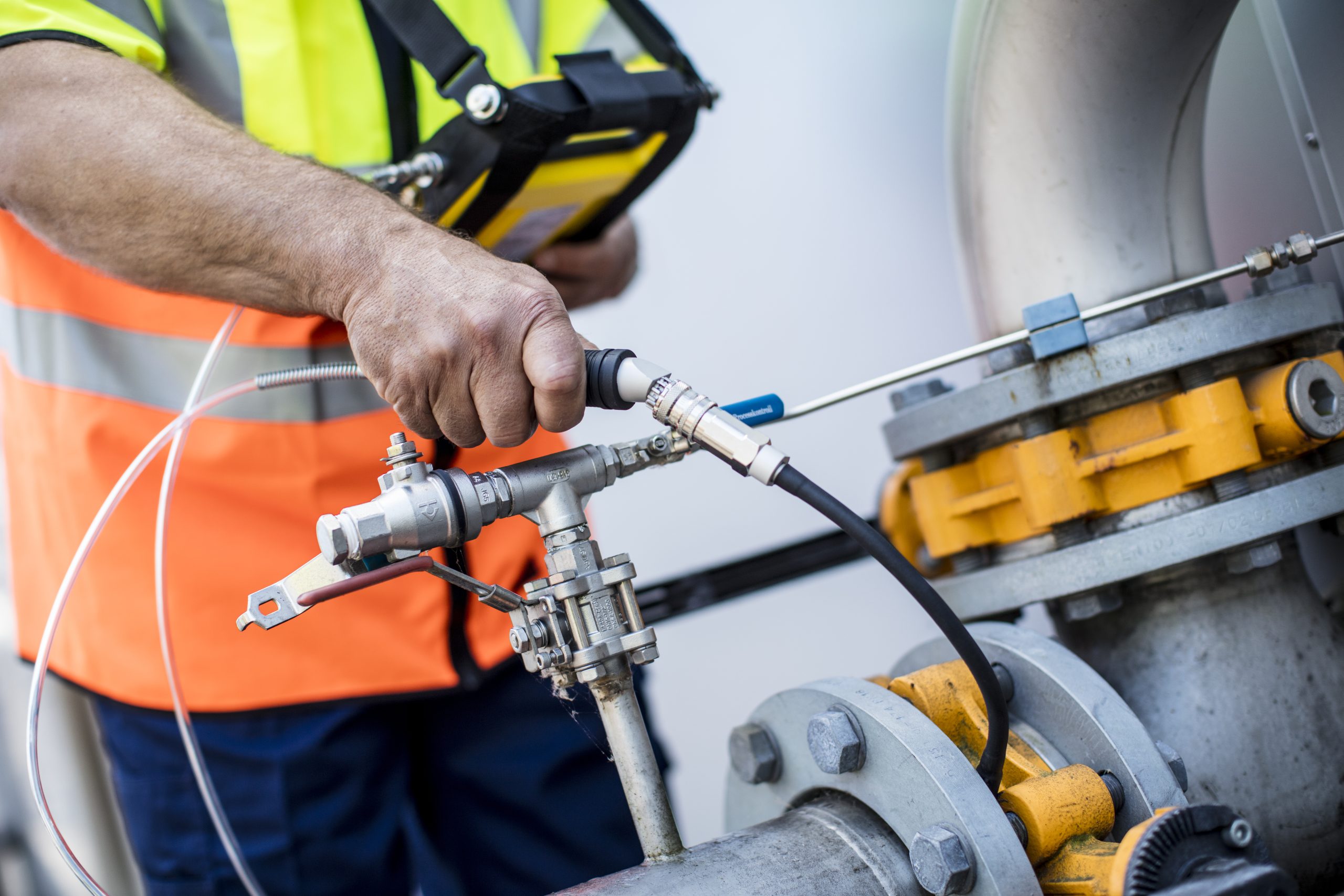
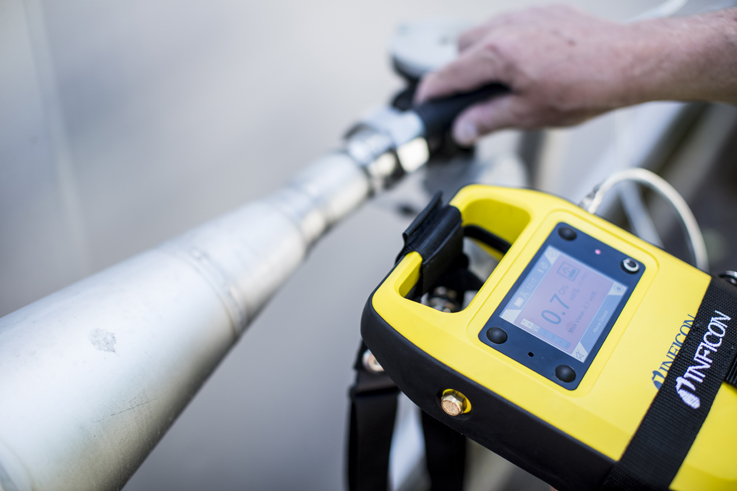
Among the most advanced of these tools is IRwin®, a rugged, intrinsically safe handheld methane detector developed for demanding field conditions. Using proprietary infrared technology, IRwin detects methane across an exceptionally broad range — from the low parts-per-million (ppm) level up to 100 percent CH4 by volume. This wide dynamic range allows a single instrument to perform both fine-scale leak screening and high-concentration confirmation, eliminating the need to switch tools mid-inspection.
What distinguishes IRwin and similar IR or laser-based detectors from traditional flame ionization detectors (FIDs) is their low cross-sensitivity to other combustible gases and humidity. FIDs, which ionize gas in a hydrogen flame, have long served as the reference for LDAR. However, they are prone to flame-outs, contamination, and false readings when exposed to moisture or exhaust gases. Such interference can interrupt inspections and reduce reliability. Optical technologies, by contrast, operate without combustion. They are inherently more stable, require less maintenance, and provide accurate readings even in variable environmental conditions.
This combination of optical precision, broad measurement range, and environmental resilience makes IR and laser detectors the new golden standard for Tier 4 LDAR under OGMP 2.0. They exceed the capabilities of the legacy “flame-based” methods by delivering equal response times, safer operation, and quantifiable results that align with the requirements of 2024/1787 and OOOOb/OOOOc. Where older instruments served as the gold standard of a previous era, IR and laser devices now set the benchmark for modern, measurement-based compliance.
Efficiency and Reliability in the Field
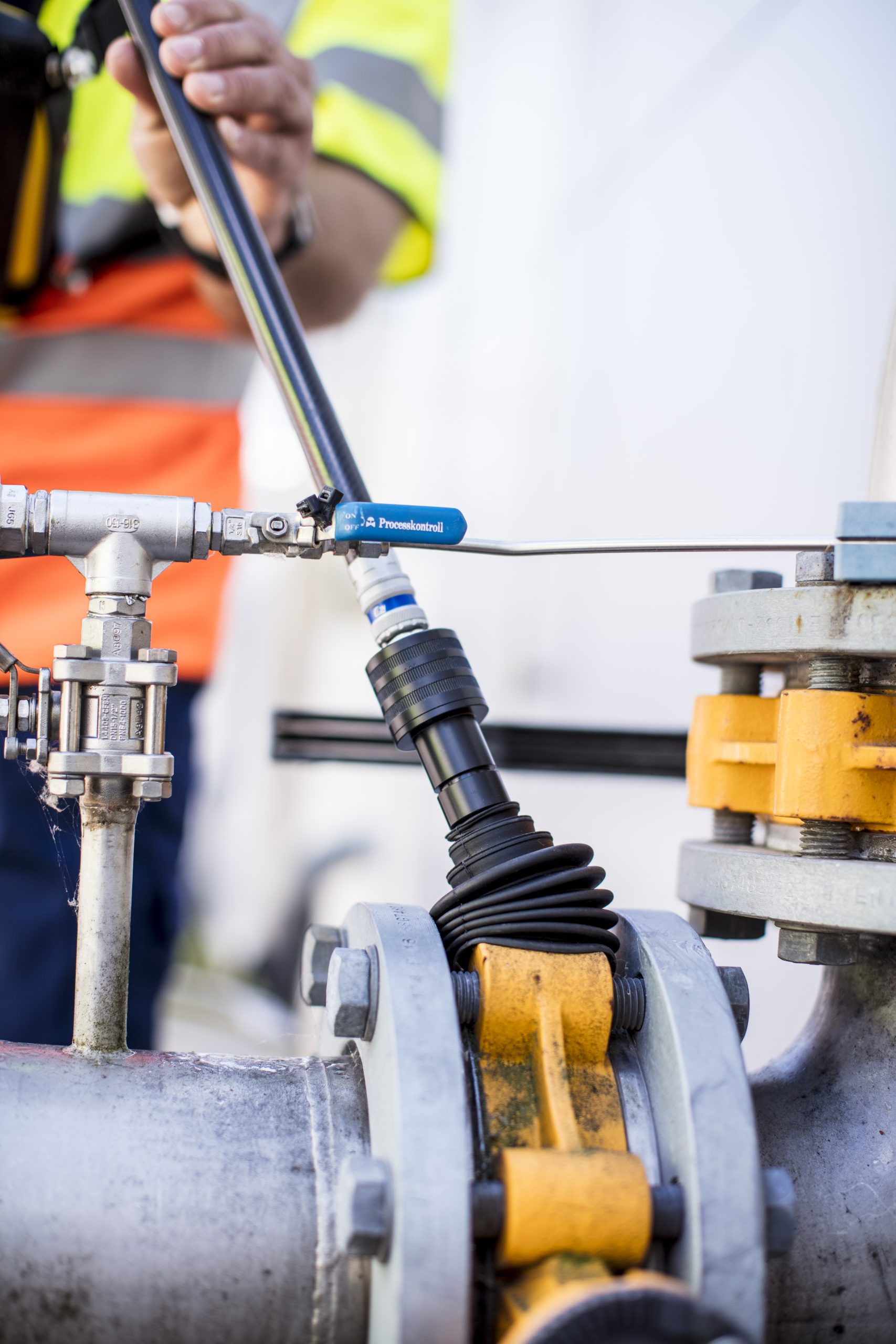
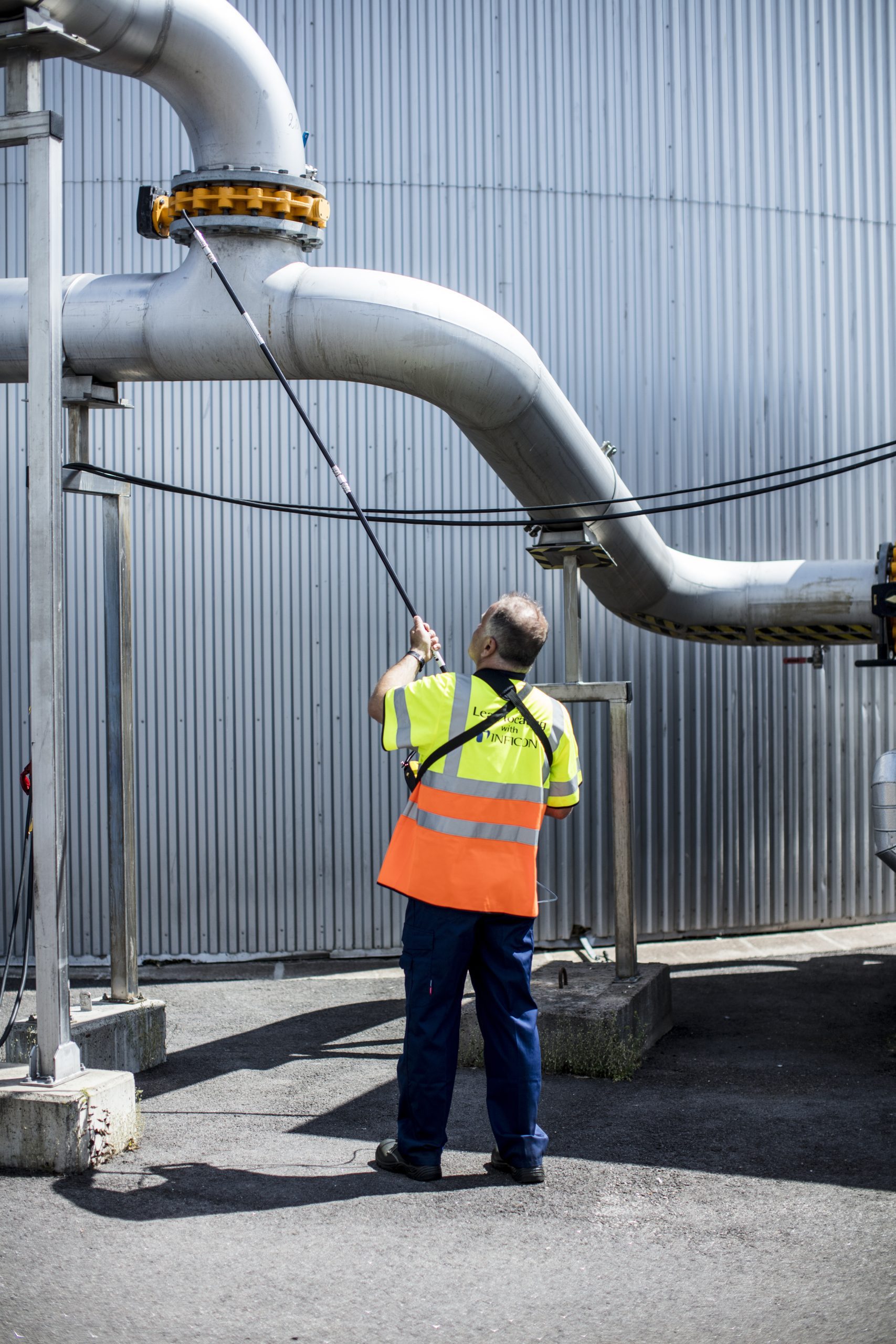
For technicians, these advances bring tangible efficiency gains. Instruments that respond within seconds and recover rapidly even after exposure to high methane concentrations, allow continuous measurement without delays. An intuitive interface and robust housing enable thorough inspection of every part of a facility, including elevated or confined areas. With extension probes and digital data-logging accessories, each reading can be recorded, time-stamped, and seamlessly integrated into a company’s digital LDAR management system.
Crucially, the same instrument that detects a leak can verify the repair. After maintenance, technicians can immediately re-measure the affected component and document the results — satisfying the “measure-repair-verify” loop required by EU 2024/1787 and the EPA OOOOc rule. This capability shortens repair cycles, minimizes downtime, and ensures that emission reductions are real and demonstrable.
Integrating Handheld Detection into Modern LDAR Programs
Remote sensing and continuous monitoring provide valuable top-down perspectives, but handheld tools remain the foundation of accurate, bottom-up data. Continuous sensor arrays can flag anomalies, while satellites and aerial surveys identify hotspots. However, handheld IR and laser detectors are needed to pinpoint the precise source, quantify its leak rate, and confirm closure. Together, these layers form an integrated emissions-management ecosystem — one that combines range, accuracy, and immediacy.
This layered approach is also consistent with regulatory philosophy. The EPA’s OOOOb and OOOOc rules encourage “advanced monitoring technologies” that achieve equivalent or superior detection compared with traditional methods. Similarly, EU 2024/1787 allows continuous or remote monitoring as alternatives to scheduled surveys, provided they deliver verified results at least as effective as the baseline LDAR frequency. In both systems, handheld optical instruments serve as the anchor for verification, linking the large-scale detection platforms to the on-site repair process.
Toward a New Standard for Compliance and Climate Performance
The implications of these developments reach far beyond technology. Under EU 2024/1787, OGMP 2.0, and OOOOb/OOOOc, operators must not only detect and repair leaks but also demonstrate the integrity of their measurements. The shift from estimated emission factors to direct quantification represents a profound change in accountability.
Well-designed instruments provide the precision needed to support this transformation. By combining quantitative rigor with operational practicality, they enable the type of source-level data that regulators, investors, and stakeholders now expect.
Infrared and laser technologies also align with broader climate goals. The Global Methane Pledge, now endorsed by more than 150 countries, calls for a 30 percent reduction in methane emissions by 2030 compared with 2020 levels. Achieving that ambition depends on technologies that make emissions visible, measurable, and correctable in real time. Handheld optical detectors are indispensable in turning these commitments into measurable outcomes.
Bridging Detection and Action
Methane mitigation succeeds only when detection leads to timely repair. By empowering technicians to pinpoint leaks, confirm fixes, and record verified data on the spot, IR and/or laser-based detectors can close the gap between identification and action. Integrated with digital reporting platforms, each measurement contributes to a traceable emissions record that satisfies both internal performance metrics and external verification standards. The result is a continuous improvement loop — detect, repair, verify, report — that turns compliance into climate progress.
Toward a Cleaner, More Transparent Energy Future
The convergence of new regulations and new technology is reshaping methane management into a discipline of precision. From the EU’s 2024/1787 regulation to the EPA’s OOOOb and OOOOc rules and the global OGMP 2.0 framework, the message is consistent: only verified measurement counts. Within this new paradigm, infrared and laser-based instruments have emerged as the most effective tools for Tier 4, bottom-up leak detection — offering wide measuring ranges, low cross-sensitivity, and dependable accuracy across diverse conditions.
IRwin exemplifies this evolution: a durable, field-proven instrument that enables compliance, enhances data quality, and accelerates methane reduction. As LDAR programs become the backbone of industrial emissions management, such tools are not merely supportive — they are essential. They bridge the gap between detection and repair, policy and practice, ambition and achievement.
With advanced LDAR technologies and optical precision leading the way, the energy sector is better equipped than ever to deliver on its climate commitments — one verified leak at a time.