


As European chemical manufacturers wrestle with increasing energy and carbon costs, more are turning to innovation. Those who see the world through this lens are embracing a new generation of monitoring technologies, which prove that process safety and operational efficiency are not competing aims but complementary ones — protecting people while improving performance and sustainability.
By Simon Bunegar, Chief Commercial Officer, Grandperspective GmbH
A Sector in Transition
Europe’s chemical industry remains one of the world’s most sophisticated and technically advanced. Yet as the European Chemical Industry Council(CEFIC) states the sector is also navigating a period of transformation. Higher energy costs and tighter carbon regulation have made plants re-evaluate their investment, production, and innovation strategies.
While some firms have chosen to scale back research and development, others such as the German chemical manufacturer in this case study see it as an opportunity to modernize. For them, innovation is not a luxury – it is the key to long-term resilience.
The plant featured in this case study has embraced innovation, investing in new technology to strengthen what was already one of the industry’s safest and most advanced operations.
At this company, process safety is part of the culture, shared by every employee, contractor, and supplier. Yet management believed that even with a strong safety record, there was room to improve visibility, detection, and prevention. So, amidst a slew of market challenges, the company decided to invest in a new layer of protection: real-time, site-wide visibility.
The Challenge: Seeing the Unseen
The facility already operated an extensive network of fixed-point sensors monitoring pipelines, flanges, valves, gaskets, and compressor station. These instruments monitor the air at fixed locations and trigger an alarm only when the target gas comes into direct contact with the sensor.
Yet even with an extensive network in place, fixed sensors have limitations in large, complex environments. They can miss low-level or intermittent emissions, especially if a leak occurs in an unmonitored area, or when the wind is in the wrong direction. Cooling agents and chemical vapors can drift into unexpected places, potentially putting people or nearby communities at risk before detection systems trigger an alert.
The company wanted an extra layer of assurance, state-of-the-art technology that could see what traditional systems could not.
A Partnership for Progress
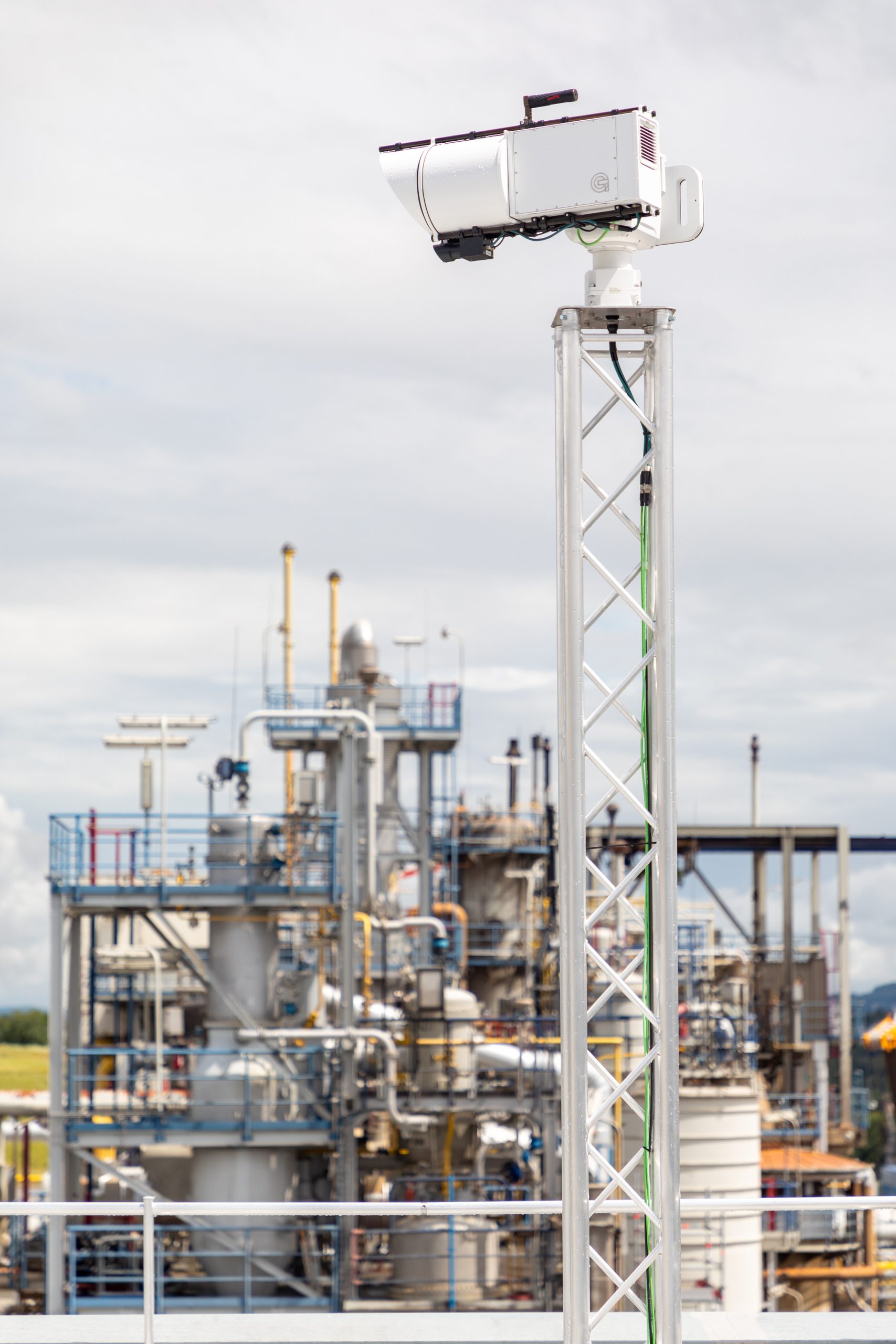
To achieve this, the firm turned to Grandperspective GmbH, a Berlin-based pioneer in ground-based remote sensing. Grandperspective’s scanfeld® system combines hyperspectral imaging with Fourier-Transform Infrared (FTIR) remote sensing to detect and visualize gases across large industrial areas.
A single scanfeld® sensor can identify and quantify more than 400 different compounds over an area of up to three square kilometres. These include typical HAPs and VOCs, ethylene oxide, vinyl chloride, hydrocarbons, methane, LNG, propane, LPG, ammonia, nitric acid, nitrous oxide and many more. It can detect emission rates as low as 0.05 kilograms per hour, providing continuous and autonomous coverage of even the most complex sites.
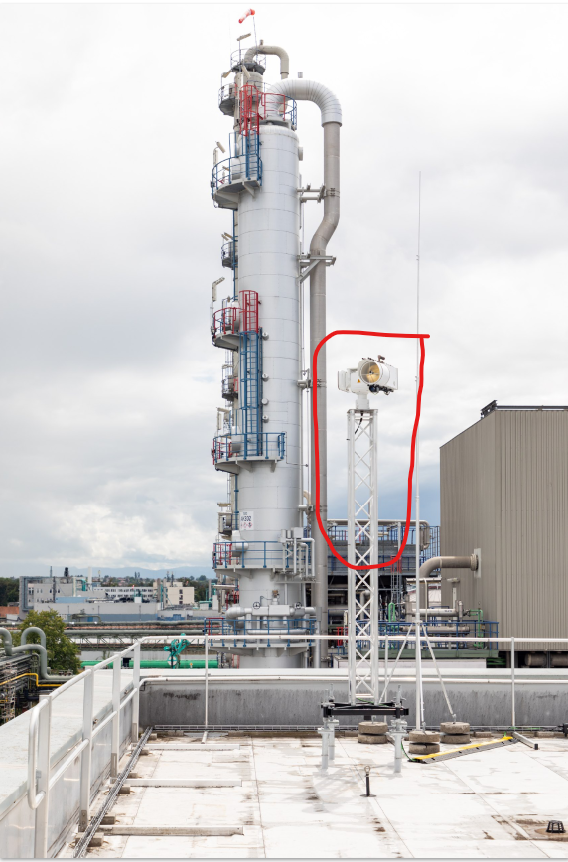
In July 2024, the first two scanfeld® sensors were installed at the plant – one on a flat rooftop and another on a six-metre truss pole attached to a 40-metre-high stack. What followed was a three-month testing and integration phase with close collaboration between our engineers and the plant’s process safety team.
Every two weeks, teams from across the site met to share insights. Peter Maas, the CEO and co-founder of Grandperspective GmbH, who sat in on meetings, recalls how plant operators “explained process layouts and potential emission sources”, while Grandperspective’s engineers “fine-tuned detection parameters and shared their field experience”. A full roll-out followed in the autumn.
Proof of Concept: Multi-Compound Detection
A key step in the trial was detecting multiple compounds, including – but not limited to – hydrochloric acid (HCl), a substance the plant handles regularly. To achieve this, a customized gas-cell setup was designed for the test, which the site’s own team then operated independently. The setup was intentionally simple: a design made from acid-resistant plastics and fitted with selected polyethylene-foil windows that offer suitable infrared transmission characteristics.
With the new arrangement in place, our engineers still needed to make a few further adjustments to the overall configuration in order to detect HCl. Our strength lies in using FTIR in passive mode within the long-wave infrared (LWIR) range. However, when it came to identifying HCl, we needed to adapt the technology and the set-up to operate in an enhanced active mode, enabling a wider spectral range with detection extending into the mid-infrared (MIR). This was a straightforward add-on to the existing system.
To achieve this, and in addition to the standard measurement approach, active measurement lines were created. These were enhanced by specially designed infrared light sources, housed in dedicated sending telescopes and positioned throughout the plant, with each unit forming one active fence line.
This enabled the system to operate in two complementary detection modes using a single platform, shedding new and invaluable light on how HCl behaves.
For example, in addition to detecting HCl in its pure form during the first test, the safety team could also see HCl actively forming during the decomposition of a different product tested in a second run. Concentrations started at zero and then rose, making it clear that the HCl was actively forming and wasn’t leftover traces from the initial pure release as had been assumed.
With far greater visibility and a deeper understanding of chemical behavior, the safety team was able to update process-safety frameworks across the plant.
Making the Invisible Visible
The scanfeld® system is able to map emissions dynamically. Each scan captures multiple angles of a gas cloud, creating a five-dimensional picture showing its length, width, height, depth, and direction of movement.
In detecting chemicals, the system visualizes how the compound builds up, disperses, and breaks down. Our Tracker Mapping module is already being used at other chemical sites to achieve this unprecedented visibility. The technology enables safety teams to follow an event in real time rather than detecting it only after it has happened. With real-time gas cloud mapping, they are able to continuously and autonomously see how the cloud forms, how it moves with the wind, and where it is heading.
At a site in the Netherlands, our technology has already allowed process safety engineers to track emissions from a chimney, where point sensors were already measuring output, as they dispersed. This validated the fixed sensor readings and improved the process safety team’s ability to model and predict emission behavior. However, when the Tracker Mapper module is integrated into the system at the German facility, it will introduce an additional degree of transparency and accountability to the process.
The Fruits of Collaboration
Through their close working partnership, the site’s project engineers identified several compounds that had previously been outside our detection library. The spectral signatures of these gases have now been added to the scanfeld® database. Once integrated, these compounds became detectable not only for this customer but for every scanfeld® user worldwide.
When a new compound is added to the global library, it instantly enhances the performance of every existing installation. It also allows users at other sites to look back through historic data and identify those compounds retrospectively — from the very first moment their scanfeld ® system began recording.
A Safer, Smarter Future
Today, a further two scanfeld® sensors have been added, taking the total to four. Collectively, they cover a large part of the plant, operating continuously and autonomously, while complementing the existing safety network and giving the process safety team a new level of visibility. As a result of this success, the German chemical manufacturer has agreed to roll-out two more scanfeld® sensors at another site, which will be operational early in 2026.
In doing so, it is further strengthening safety and resilience, already strong to begin with, while setting a benchmark for what world-class process safety can look like.